
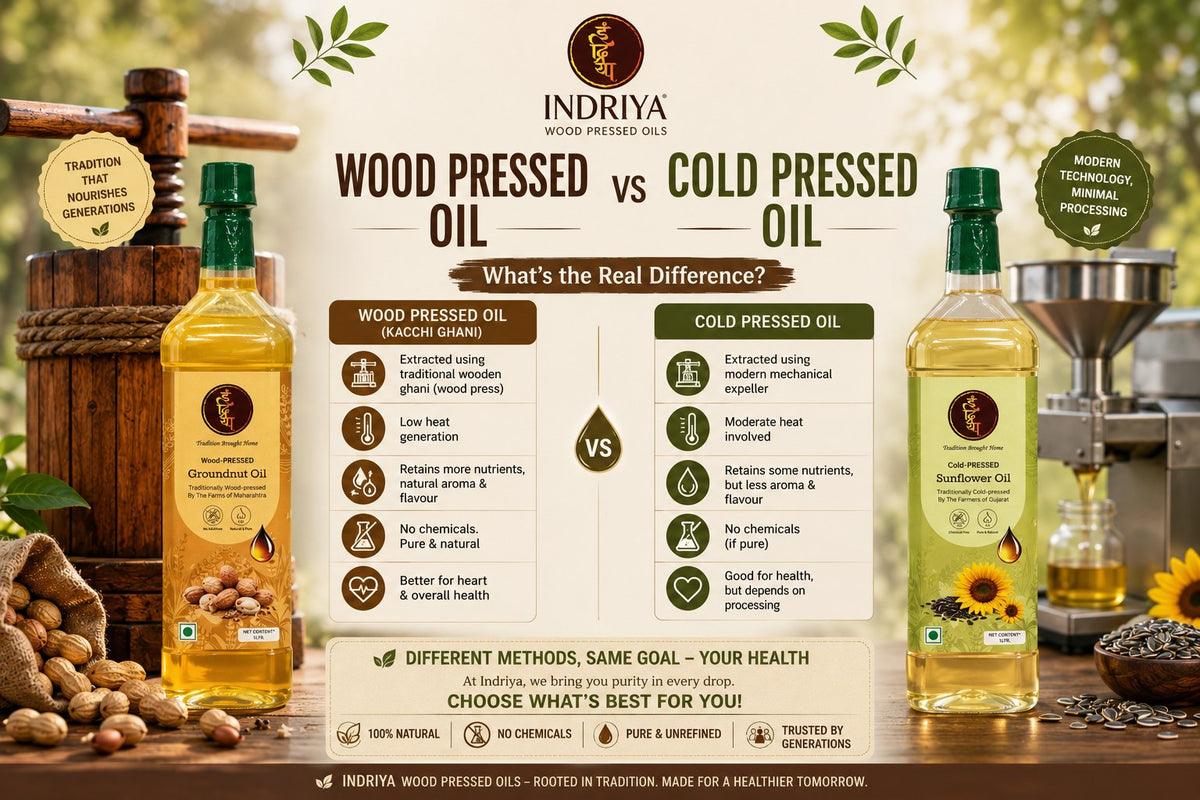
Wood-Pressed vs Cold-Pressed Oil: What's the Real Difference?
If you've been shopping for cooking oil, you've probably seen labels like “wood-pressed,” “cold-pressed,” “Kachi Ghani,” and “unrefined.” They can sound similar, but they don't always describe the same process.
So what's the real difference between wood-pressed and cold-pressed oil? Does the extraction method affect flavour, aroma, and processing? And which one should you choose for everyday cooking?
The short answer: both can be minimally processed, but the equipment and extraction conditions differ.
Wood-pressing is a traditional method using a wooden ghani, focused on slow extraction with minimal intervention. Cold-pressing is a broader term for oils extracted without deliberately applying high heat—and it can involve modern mechanical equipment.
Let's break it down so you know exactly what you're buying.
What Does Cold-Pressed Oil Mean?
“Cold-pressed” generally describes an extraction process where the oil isn't intentionally heated to high temperatures. The exact definition and temperature threshold can vary by product, standard, and market.
Cold-pressed oils are often produced using mechanical expeller presses. The process is designed to keep temperatures relatively low, but friction and pressure during mechanical extraction can still generate some heat.
That's why “cold-pressed” alone doesn't tell you everything. It's worth also checking how the oil was extracted, whether it was refined afterward, and what the manufacturer says about processing.
What Is Wood-Pressed Oil?
Wood-pressed oil is made using a traditional wooden ghani, or wood-based pressing system. In India, this style is also commonly associated with the term “Kachi Ghani,” though the exact process can vary between producers and oilseeds.
The key idea is slow, traditional mechanical extraction rather than aggressive industrial processing.
Because the process is gentler, the oil can retain much of the natural aroma, colour, and characteristic flavour of the seed—depending on the oilseed and how it's produced.
Wood-pressing is especially valued for oils like:
- Mustard Oil
- Groundnut Oil
- Sesame Oil
- Coconut Oil
These oils are often appreciated for their natural character and distinctive taste.
Wood-Pressed vs Cold-Pressed: The Core Difference
Think of “cold-pressed” as a description of extraction conditions, and “wood-pressed” as a specific traditional pressing method.
Wood-pressed oil uses a traditional wooden ghani. Cold-pressed oil can be made using various mechanical presses, including modern expeller systems.
The two terms overlap, but they shouldn't be treated as identical.
A genuinely wood-pressed oil tells you more about the specific pressing method used.
A Simple Side-by-Side Comparison
Extraction Method
Wood-pressed: Traditionally extracted using a wooden ghani, generally a slower mechanical process.
Cold-pressed: Mechanically extracted without deliberate high heat; modern expeller equipment may be used.
Processing After Extraction
Wood-pressed: Often sold minimally processed or unrefined—but always check the label.
Cold-pressed: May also be sold unrefined, but the term alone doesn't guarantee no further processing.
Heat Generated
Wood-pressed: The slower approach aims to minimise heat, though actual temperature depends on equipment and conditions.
Cold-pressed: Designed to avoid deliberate high heat, but mechanical friction can still generate some heat.
Flavour & Aroma
Wood-pressed: Often has a more pronounced, natural aroma reflecting the original oilseed.
Cold-pressed: Can also retain natural flavour, depending on the seed, equipment, and processing.
The takeaway: Don't judge an oil by one label alone. Look at the complete production process.
Why Does the Extraction Method Matter?
The journey from seed to bottle involves several stages. The more processing an oil undergoes, the more its natural colour, aroma, and flavour may change.
Refined oils are typically processed for a consistent appearance, neutral flavour, and longer shelf stability—often involving processes such as filtration, neutralisation, bleaching, and deodorisation.
Wood-pressed, minimally processed oils take a different approach: extract mechanically while keeping processing as simple as practical.
That's one reason traditionally pressed oils often look, smell, and taste more like the original seed.
Does Wood-Pressed Oil Taste Different?
For many people, the most noticeable difference is sensory.
Wood-pressed mustard oil can carry the characteristic pungent aroma of mustard seeds. Wood-pressed groundnut oil often has a distinctly nutty taste. Sesame oil can retain a familiar roasted, seed-like character, depending on the seeds and production method.
This natural variation isn't a flaw. In minimally processed oils, aroma, colour, and flavour reflect the raw material and how it was extracted.
If you're used to neutral refined oils, your first taste of a traditionally pressed oil can feel surprisingly different.
Is Wood-Pressed Oil More Nutritious?
The honest answer is more nuanced than a simple yes.
Oil quality depends on several factors, including:
- The quality and freshness of the seed
- Storage conditions
- Extraction conditions
- Processing after extraction
Minimally processed oils can retain naturally occurring compounds that may be reduced during extensive refining.
Wood-pressing appeals to many because it combines traditional extraction with minimal processing—but the nutritional profile still depends on the specific oil.
It's better to choose a genuine, well-made, minimally processed oil than to rely on a single marketing term.
Wood-Pressed vs Refined Oil
If your main concern is choosing a less processed cooking oil, the more useful comparison is often wood-pressed versus refined.
Refined oils are processed to reduce strong colour, aroma, and flavour, aiming for consistency and stability.
Wood-pressed oils aim to preserve more of the oil's natural character—often with a stronger aroma, deeper colour, and shorter practical shelf life, depending on the oil and storage conditions.
Neither label alone tells the whole story. Always check the ingredient list, processing information, and storage instructions.
Which Oil Should You Choose?
Choose Wood-Pressed Oil If:
- You want a traditionally extracted oil.
- You prefer minimally processed oils.
- You enjoy the natural aroma and flavour of the oilseed.
- You want an oil that retains more of the seed's natural character.
Choose a Good Cold-Pressed Oil If:
- You want mechanical extraction without deliberate high heat.
- You prefer a particular oilseed's natural flavour.
- You've verified how the oil is processed after pressing.
Choose Refined Oil If:
- Your priority is a neutral flavour.
- You prefer a consistent appearance.
- You specifically want the characteristics of a refined cooking oil.
For everyday cooking, the best choice is ultimately an oil that fits your cooking style, taste preferences, and diet—and one whose production and ingredients you trust.
Why Does Wood-Pressed Oil Cost More?
Traditional pressing costs more because the process is slower and generally produces lower yields than highly industrialised extraction and refining.
There are also added costs associated with:
- Quality oilseeds
- Careful handling
- Filtration
- Packaging
- Storage
- Shorter inventory cycles
So when you compare a wood-pressed oil's price to a refined oil's, you're not necessarily comparing two bottles made using the same production philosophy.
With wood-pressed oil, part of what you're paying for is the care taken during extraction and the effort to preserve the natural character of the oil.
Why We Choose Wood-Pressing at Indriya
At Indriya, we believe cooking oil should be more than something you simply pour into a pan—it's an everyday ingredient, and how it's made matters.
Our oils are made using traditional wood-pressed methods, focused on simple mechanical extraction and minimal processing.
We work with oilseeds sourced from different parts of India, bringing their natural character to your kitchen.
Our range includes:
- Wood-Pressed Groundnut Oil
- Wood-Pressed Mustard Oil
- Wood-Pressed White Sesame Oil
- Wood-Pressed Coconut Oil
- Wood-Pressed Sunflower Oil
- And more
We don't want you to choose Indriya just because we say wood-pressing is better.
We want you to understand the process, taste the difference, and decide for yourself.
Because when you know what's in your bottle—and how it got there—choosing your everyday cooking oil becomes much easier.
Experience the Purity
Experience the pure, wholesome goodness of Indriya Wood Pressed Oils.
👉 Shop the Indriya Collection Today
Have you tried cooking with wood-pressed oils?
💬 Share your experience in the comments below—we'd love to hear from you!
Wood-pressed and cold-pressed sound like the same thing — they're not. Here's what actually separates them, and which one deserves a place in your kitchen.


Join the conversation